
A hand operated hydraulic press is one of the most useful machines in any workshop – and one of the most misused. The moment operators treat it as a simple tool rather than a machine with real force behind it, things go wrong fast. Bent frames, blown seals, snapped workpieces, and in worst cases, operator injuries – all of these traces back to skipped steps and shortcuts that seemed harmless at the time.
This guide walks through the correct way to operate a hand operated hydraulic press, from the moment you approach the machine to the moment you release pressure and call the job done. Whether you work in an automobile repair shop, a bearing fitting unit, or a general fabrication workshop, these steps apply to your daily work. And if you are evaluating equipment sources, understanding how your machine is built matters just as much as how you use it – which is why sourcing from a trusted hydraulic press (hand operated) manufacturer in Rajkot makes a measurable difference in machine behaviour under load.
Understand the Machine Before You Touch the Handle
Most operators who get hurt on a hydraulic press are not beginners – they are experienced workers who stopped paying attention. Familiarity breeds carelessness, and carelessness on a machine capable of generating 10, 20, or 50 tons of force has predictable consequences.
Before any operation begins, take two minutes to understand what you are working with. A hand operated hydraulic press works on Pascal’s principle – force applied to the hand pump lever pushes hydraulic oil into the cylinder, driving the ram downward with significantly amplified force. The double-plunger pump design gives you fast advance at low pressure and slow, powerful advance at high pressure. This two-stage action means the ram moves before full pressure builds, and operators who miss this often position their workpiece incorrectly.
Check the pressure gauge before every session. If the system shows residual pressure from a previous job, bleed it off using the release valve before loading a new workpiece. Starting a press stroke with pressure already in the system is one of the most common causes of uncontrolled ram movement.
Pre-Operation Checks That Cannot Be Skipped
Inspect the Frame and Ram Visually
Look at the H-frame before you press anything. Cracks, weld distortions, or visible bending in the side columns are signals that the machine has been overloaded at some point. A frame that has been structurally compromised will not fail you gradually – it will fail you suddenly, under load. Run your eye along the columns and the crossbeam every single morning before work begins.
Check the ram as well. The chrome-plated surface of the ram should be clean and free of pitting, scoring, or surface rust. A damaged ram surface tears through seals quickly, which leads to oil leaks and pressure loss during operation. Wipe the ram down with a clean cloth before each use – it takes ten seconds and extends seal life considerably.
Check Hydraulic Oil Level and Quality
The oil reservoir is usually accessible via a filler cap on the tank body. Check oil level cold, before the machine has been running. Low oil causes the pump to draw air, which creates inconsistent pressure and a spongy, unpredictable ram stroke.
Hydraulic oil that has turned dark, cloudy, or carries a burnt smell has broken down and needs replacing. Contaminated oil accelerates wear inside the pump and cylinder and causes the pressure relief valve to behave erratically. Most manufacturers recommend a full oil change every 500 operating hours or once a year.
Set the Work Table at the Correct Height
The adjustable work table is positioned using load pins inserted into holes in the column. The table must rest securely on both pins and sit level before the workpiece is placed. A tilted table causes uneven load distribution during the press stroke, which can cause the workpiece to shift, crack, or eject laterally.
Set the table so the workpiece sits within the ram’s working range – not so far down that the ram reaches full extension before contact, and not so high that there is no room to travel through the operation. Usable ram stroke on most hand operated workshop presses runs between 150 mm and 250 mm depending on capacity.
Correct Operating Technique During the Press Stroke
Position the Workpiece Properly
Centre the workpiece directly under the ram. Off-centre loading creates a side force on the ram that the cylinder seals and guides are not designed to handle. Over time, repeated off-centre pressing causes the ram to develop lateral play, destroying seal integrity and leading to leaks.
Use V-blocks when pressing round workpieces like shafts, pins, or rollers. The V-block set supplied with most hand operated presses holds cylindrical workpieces stable and prevents them from rolling under load. Pressing a round shaft without V-blocks is how operators end up chasing a workpiece across the shop floor.
Apply Pressure Gradually – Never Jerk the Handle
The hand pump lever should be operated in smooth, controlled strokes. Jerking the lever sharply does not increase pressing force – it creates pressure spikes that can momentarily exceed the relief valve setting and stress the cylinder end caps and seals. Smooth strokes allow the operator to feel resistance build up, which gives real feedback about what is happening at the workpiece.
When the workpiece begins to resist – a bearing fighting the bore, a pin harder than expected – slow down further, not speed up. Excessive force applied too quickly can crack the workpiece, damage the tooling, and in some cases cause the work table support pins to deform.
Watch the Pressure Gauge Throughout
The pressure gauge fitted to the oil tank is there to be used, not ignored. Every job should be run within a known pressure range. Most hand pressing operations – bearing fitting, bushing extraction, shaft straightening – do not require anywhere near the machine’s maximum rated capacity. If the gauge is climbing toward the machine’s pressure limit and the workpiece has not moved, stop. Re-examine the setup before applying more force.
The pressure relief valve protects the hydraulic system from overload, but it is a last resort safety device, not a regular operating control. If your jobs are routinely hitting the relief valve, you either need a higher capacity machine or a different approach to the operation.
Safety Practices Every Operator Must Follow
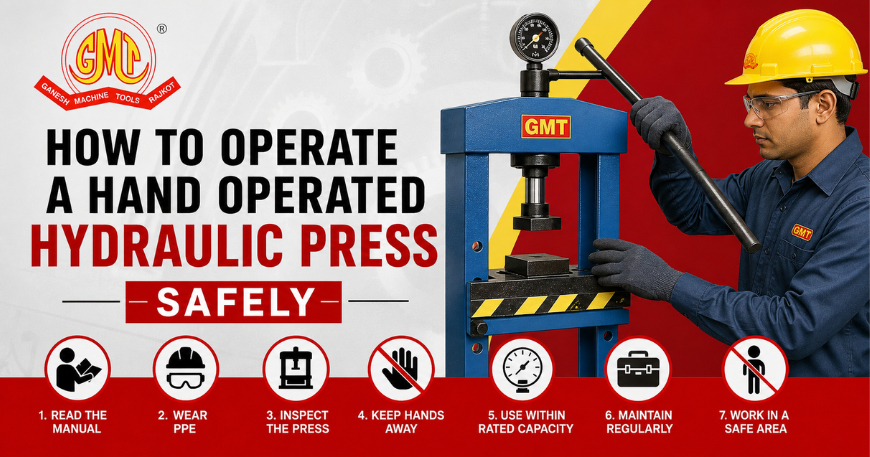
Eye protection is not negotiable when operating a hydraulic press. Workpieces under extreme compression can fracture and send fragments in unpredictable directions. Safety glasses or a face shield stay on from the first pump stroke to the moment pressure is fully released.
Keep hands away from the working zone during the press stroke. Use tools – V-blocks, die sets, support plates – to position and hold workpieces. Direct hand contact with a workpiece under an active ram is never appropriate.
Never exceed the machine’s rated capacity. A 10-ton press is not a 12-ton press with extra effort on the handle. Operating beyond rated capacity damages pump components, distorts the frame, and voids any manufacturer warranty. If the job demands more force, the answer is a higher capacity machine.
Release pressure fully after every job. Do not leave the system pressurised between operations or overnight. Sustained system pressure accelerates seal fatigue and causes slow internal leaks that are difficult to diagnose until significant damage has occurred.
When to Call the Manufacturer – Not Just a Local Mechanic
Most hand operated hydraulic press problems fall into three categories: pressure loss, oil leaks, and inconsistent ram travel. All three are diagnosable and fixable, but they require proper hydraulic knowledge and the correct seals for your specific machine.
A local mechanic unfamiliar with hydraulic systems will often fit generic seals that do not match the cylinder bore tolerances – producing a fix that fails again within weeks. The better path is to contact the original manufacturer directly for genuine parts and service guidance.
This is particularly relevant for workshops running multiple machines – press, tapping, drilling – alongside each other. A workshop sourcing from a quality electric tapping machine manufacturer in Rajkot understands this standard: machines built to proper specifications behave predictably and are serviceable with genuine parts. The same logic applies to your press.
Operating Safely Is a Daily Habit, Not a One-Time Training
Safe operation of a hand operated hydraulic press is not something you do once after reading a manual. It is a discipline built through daily habits – the pre-shift visual check, the oil level glance, the smooth pump strokes, the pressure gauge watch, and the full pressure release at the end of every job.
Workshops that build these habits into their routine rarely face major press failures. The machine rewards consistent care with years of reliable service. Those that skip checks and rush strokes tend to deal with seal failures, frame damage, and downtime that costs far more than the two minutes the morning inspection would have taken.
If you are setting up a press operation for the first time or replacing older equipment, speak directly with a hydraulic press (hand operated) manufacturer in Rajkot about correct machine sizing for your jobs. Getting capacity right from day one is the most important safety decision you will make before the first stroke is ever pumped.