
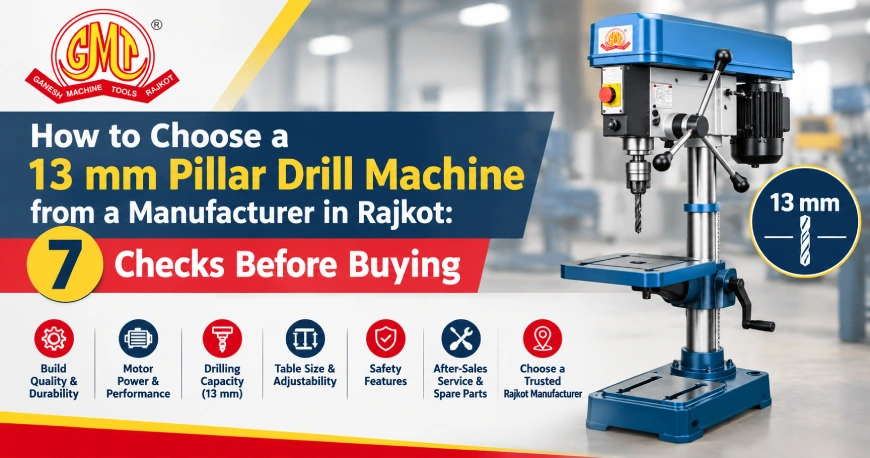
A 13 mm pillar drill machine is usually the first tool a new workshop buys and the last one it replaces, so the decision deserves more attention than it gets. Rajkot’s engineering cluster ships thousands of these machines every year, and the quality gap between a good one and a poor one never shows in a catalogue photo. This guide covers seven checks that separate a drill that holds accuracy for a decade from one that wobbles within a year, the same checks a reliable 13 mm pillar drill machine manufacturer in Rajkot should welcome.
The best 13 mm pillar drill machine for a workshop has a motor of at least 0.5 HP (0.37 kW), a Morse taper 2 spindle, five or more speed steps, a rigid cast-iron column and base, and a chuck runout below 0.05 mm. Check these first, then confirm spare-parts support from the manufacturer.
What Does “13 mm” Actually Mean on a Pillar Drill?
The 13 mm figure is the largest drill shank the chuck can grip, not a promise about what the machine can cut. A Jacobs-style chuck closes on shanks up to 13 mm (half an inch), but whether the motor and spindle can push that bit through steel depends on everything else in this guide.
The first check is an honest capacity rating. Ask the seller to quote it in a named material, because a machine that drills 13 mm in aluminium may stall at 10 mm in EN8 steel. A fair claim reads “13 mm in mild steel, continuous duty,” not “13 mm” on its own.
Cutting speed shows why the rating matters. High-speed steel drills cut mild steel at roughly 25 to 30 metres per minute, which works out to about 660 rpm for a 13 mm bit. A machine whose lowest speed sits at 1,200 rpm will burn drills at full diameter, whatever the brochure says.
Check the Motor and Speed Range Before Anything Else
The motor sets the ceiling for every other specification, so it gets inspected before the paint and the badge.
Motor power and phase
A 0.5 HP (0.37 kW) motor is the practical minimum for a 13 mm pillar drill, and 1 HP (0.75 kW) is the sensible pick if the shop drills steel daily. Single-phase motors suit small units on domestic-grade supply, while three-phase motors run cooler under load and pull through steel more smoothly. Read the nameplate yourself: rated current, insulation class and motor make all tell you more than the sales pitch.
Speed steps and drive type
Speed range decides how many jobs one machine can take on. A 3 mm hole in steel wants around 2,800 rpm, while a 13 mm hole wants closer to 600, so a spread of roughly 300 to 2,500 rpm covers most daily work. Most 13 mm machines get there with five to twelve steps, changed by moving a V-belt across stepped pulleys. Geared-head machines replace the belt with a selector lever. The comparison below shows the trade.
| Feature | Belt-drive pillar drill | Geared-head pillar drill |
| Speed change | Move belt across pulleys | Lever or selector |
| Power transfer | Can slip under heavy load | Positive, no slip |
| Upkeep | Periodic belt replacement | Gear oil checks |
| Purchase price | Lower | Higher |
| Best suited to | General workshops, mixed jobs | Repetitive steel drilling |
Belt-drive wins for most small and mid-sized shops because a worn belt costs a few hundred rupees to replace and takes ten minutes.
Which Spindle, Chuck and Quill Details Affect Accuracy?
Accuracy lives in the spindle assembly, and three details tell you almost everything about it.
The third check is the spindle taper. Morse taper 2 is the standard on 13 mm machines, and it lets the chuck arbor seat firmly by friction alone. Ask whether the spindle runs on tapered roller or deep-groove ball bearings, and whether the bearings are branded.
The fourth check is quill travel and depth control. A quill travel of 50 to 65 mm is typical for this class, and the return spring should lift the quill smoothly without slamming. Wind the feed handle through its full stroke and feel for stiff spots, then set the depth stop and confirm it holds when you drill three test holes.
The runout test is the check that exposes a weak build. Clamp a dial indicator to the table, rest its tip on a test bar held in the chuck, and rotate the spindle by hand. Readings under 0.05 mm are acceptable for general drilling, and anything beyond 0.1 mm means oversize holes and short drill life.
Why Do the Column, Base and Table Decide Long-Term Accuracy?
A rigid structure keeps the drill square to the work, and rigidity comes from mass and good casting. The fifth check is simply how the machine behaves when pushed. Press sideways on the head with one hand while watching the chuck, and any visible give means the column and base will flex under a 13 mm bit.
Cast iron is the right material for the base, table and head because it damps vibration that steel fabrications pass straight to the drill.
Table quality deserves a separate look. A good table has clean T-slots, a rack-and-pinion height lift, and a positive lock on both the column clamp and the swivel. Place a try square against the column and the table and look for light under the blade. A table that sits even one degree off square will drill every hole at an angle.
Throat distance, the gap from the spindle centre to the column, limits the width of plate you can drill without clamping off the table. Measure it against your largest regular job before you pay.
What Should You Ask a 13 mm Pillar Drill Machine Manufacturer in Rajkot Before Paying?
Support and paperwork form the sixth and seventh checks, and they cost nothing to verify. The first question is whether you are dealing with the manufacturer or a trader, because only a manufacturer controls the casting quality, machining tolerances and spare-parts stock.
Warranty terms need to be written down. A twelve-month warranty on the motor and spindle assembly is a reasonable baseline, with clear wording on what counts as wear. Ask which spares are held in stock: belts, chucks, arbors, bearings and quill return springs should all be available within days, not weeks. A manufacturer such as [Brand Name] earns trust here by naming part numbers and lead times rather than offering assurances.
Many workshops in the city buy a drill and a lathe from the same supplier. If you are also looking at a lathe machine in Rajkot or comparing heavy duty lathe machine price quotes, ask for both on one invoice with one service contract, because a combined order gives you better room to negotiate.
Finally, request a test drilling demonstration on your own material. A machine that cuts a clean 13 mm hole in a plate you supply has answered most of your questions already.
FAQ: Buying a 13 mm Pillar Drill Machine
What is the best motor power for a 13 mm pillar drill machine?
A 0.5 HP (0.37 kW) motor handles occasional steel work, while 1 HP (0.75 kW) suits daily drilling in steel. Three-phase motors run cooler under sustained load, so they are the better pick wherever the supply allows.
How much does a 13 mm pillar drill machine cost in India?
Most belt-drive models fall in a planning range of roughly ₹20,000 to ₹60,000, depending on motor power, build weight and whether the machine is bench or floor mounted. Geared-head versions cost more, so ask [Brand Name] or any other supplier for itemised quotes rather than headline prices.
Can a 13 mm pillar drill machine cut steel?
Yes, provided the motor is at least 0.5 HP and the speed drops to around 600 rpm for the full 13 mm diameter. Drilling a pilot hole of 5 to 6 mm first reduces load on the motor and extends drill life.
Is a belt-drive or geared-head pillar drill better?
Belt-drive suits most workshops because it is cheaper and simple to repair. Geared-head is worth the extra cost only for repetitive steel drilling where belt slip would become a daily nuisance.
How often should a pillar drill be serviced?
Grease the spindle bearings and inspect the belt every six months in a busy shop. Check the table and column clamps monthly, since loose clamps cause most accuracy complaints.
Take a dial indicator and a ground test bar when you visit the supplier, because those two tools will tell you more in five minutes than any datasheet. Run the sideways push test, rotate the spindle by hand, and drill a plate from your own stock before discussing price. A 13 mm pillar drill machine manufacturer in Rajkot who encourages all of that is probably building machines meant to last, and one who hesitates has told you what you needed to know.