
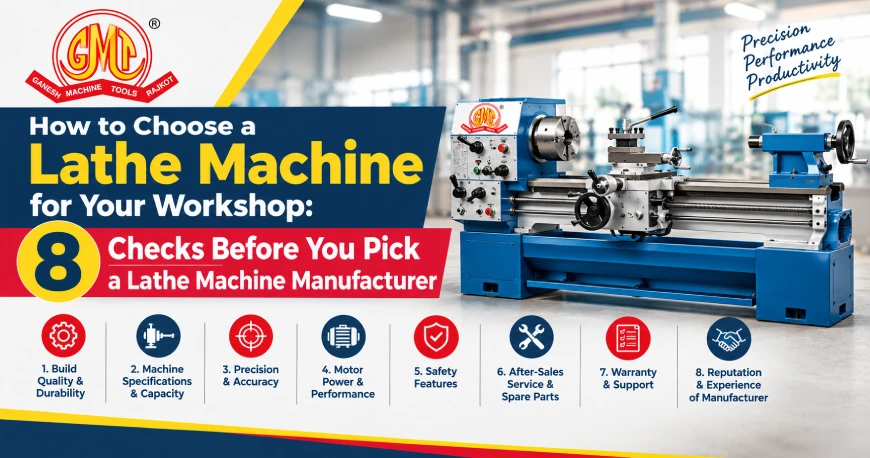
A lathe machine stays on the shop floor for twenty years or more, so a poor purchase gets paid for on every working day. Most buyers compare horsepower and price, then discover later that bed hardness, spindle bore and spare-parts support mattered more. This guide walks through eight checks that separate a dependable lathe from a problem machine, and shows what a serious lathe machine manufacturer should be ready to prove before any money changes hands.
The right lathe machine matches its centre height and bed length to your largest regular job, rests on a hardened cast-iron bed, has a spindle bore wide enough for your bar stock, and carries a motor of 5 HP or more for steel. Ask the lathe machine manufacturer for signed accuracy test records before paying.
What Size Lathe Machine Does Your Workshop Actually Need?
Size comes down to two numbers: centre height and distance between centres. Centre height is the gap from the bed to the spindle axis, and doubling it gives the swing over the bed, so a 200 mm centre height lathe turns work up to about 400 mm in diameter.
Swing over the cross-slide is always smaller than swing over the bed, so check both numbers against your widest part before trusting the headline figure.
The first check is to size the machine to your largest regular job, not your largest imaginable one. A lathe with a 3 m bed bought for the occasional long shaft wastes floor space and money every other week, and outsourcing the rare job costs far less.
The second check is bed length. Distance between centres, the longest piece you can hold between headstock and tailstock, is commonly 1,000, 1,500, 2,000 or 3,000 mm. A gap-bed design adds a removable section beside the chuck for larger discs and flanges, at the cost of slightly shorter supported length. The table below shows typical duty classes.
| Duty class | Centre height | Spindle bore | Motor | Typical work |
| Light | 125–150 mm | 38 mm | 2–3 HP | Small parts, tool room |
| Medium | 175–200 mm | 52 mm | 5 HP | General job shop |
| Heavy | 250–400 mm | 80 mm and above | 7.5–15 HP | Shafts, rolls, large castings |
Bed, Headstock and Spindle: Where Accuracy Comes From
Accuracy in a lathe is built into the bed and headstock long before any tool touches metal, and two checks cover them.
Bed construction
The third check is the bed itself. Look for grey cast iron with induction-hardened and ground ways, at a hardness near 45 HRC, because soft ways wear into a taper within a few years. Ask whether the castings were naturally aged or stress-relieved before machining. An unseasoned casting slowly twists as internal stress releases, and no later adjustment fixes that.
Weight offers a quick sanity test. A medium-duty 1.5 m lathe commonly weighs 1,000 kg or more, and a machine far lighter than its rivals has usually saved material in the bed.
Spindle bore, nose and speeds
The fourth check is the spindle assembly. A 52 mm bore passes 50 mm bar through the headstock, which decides whether you can feed stock instead of cutting it short. Confirm the spindle nose type (D1-4, D1-6 or A2-6, for example) so chucks are easy to source, and ask for preloaded tapered roller bearings.
Headstock gears deserve a listen as well. They should be hardened and ground alloy steel, because soft gears whine at speed and chip teeth under shock loads. Run the machine through every speed without load and listen for rhythmic knocking.
Speed range matters at both ends. Turning a 100 mm shaft in mild steel with high-speed steel tooling at 25 m/min needs about 80 rpm, so a geared head offering 8 to 16 steps from roughly 40 to 1,800 rpm covers both heavy roughing and fine finishing.
How Much Motor and Feed Capability Does a Heavy Duty Lathe Need?
Power and feeds decide how hard the machine can work without complaining, and the fifth and sixth checks sit here.
The fifth check is motor power at the speeds you actually use. Five horsepower (3.7 kW) is a sensible floor for steel on a medium lathe, while centre heights above 250 mm call for 7.5 to 10 HP. Low-speed torque matters more than the nameplate figure, because heavy cuts happen at 80 to 200 rpm, not at the top of the range.
Electrical fittings finish the picture. A three-phase 415 V motor with a star-delta starter, an overload relay and a spindle brake protects both the motor and the operator, and costs little at the factory compared with retrofitting later.
The sixth check is the feed and threading system. A quick-change gearbox with both metric and inch threading saves hours of change-gear fiddling on repeat jobs. Look for a separate feed rod beside the lead screw, which keeps the lead screw fresh for threading and prevents the wear that ruins thread pitch.
What Should You Check on the Tailstock, Carriage and Test Records?
The seventh check is proof of accuracy, and it begins with the tailstock and carriage. The tailstock quill should slide smoothly and lock without shifting the centre, and the carriage should move along the bed without binding at any point.
A reputable maker supplies a test chart recording spindle runout, tailstock alignment and carriage parallelism, signed and dated per machine. Commonly accepted limits keep spindle nose runout within 0.01 to 0.02 mm and taper within 0.02 mm over 100 mm of turned length. A chart with identical numbers on every machine suggests the figures were copied, not measured.
Then run your own turning test. Turn a bar held between centres, measure both ends with a micrometer, and compare the readings against the chart before you accept delivery.
Safety fittings belong on the checklist too. A chuck guard, an emergency stop within easy reach and a coolant pump with a clean tank are standard on a properly finished machine.
What Should a Lathe Machine Manufacturer Show You Before You Pay?
Support and total cost form the eighth check, and a good lathe machine manufacturer answers both openly. Start with spare parts: gears, bearings, lead-screw nuts, chuck backplates and clutch plates should ship within days, with part numbers on paper. A manufacturer such as [Brand Name] earns confidence by showing its stock list and service response times, not by promising them.
Price needs context. As a planning range, a heavy duty lathe machine price between 1.5 and 3 m falls roughly between ₹4 lakh and ₹15 lakh for conventional models, with CNC versions far above that. A lower quote often hides thinner castings, unbranded bearings or a missing feed rod, so compare specification line by line.
Location helps more than most buyers expect. Choosing a lathe machine in Rajkot means a works visit, a quick service call and fast spare supply are all within a day’s reach. Ask any shortlisted supplier to let you watch a machine cut your material before the order is placed.
Installation counts as well. Ask who levels the machine, how long commissioning takes and whether the operator receives training. Levelling on a proper foundation with a precision level takes half a day and protects the bed from twisting.
Frequently Asked Questions
How much does a heavy duty lathe machine cost in India?
Conventional heavy duty lathes between 1.5 and 3 m typically cost between ₹4 lakh and ₹15 lakh, depending on centre height, spindle bore and motor power. CNC models start well above that range, so always request an itemised quotation.
What is the difference between a gap-bed and a straight-bed lathe?
A gap-bed lathe has a removable section next to the headstock that allows larger-diameter work to swing. A straight bed is stiffer and supports work continuously, which suits long shafts.
Which lathe machine is best for a small workshop?
A medium-duty lathe with a 175 to 200 mm centre height, 1,000 to 1,500 mm bed and 5 HP motor handles most general jobs. It turns work up to roughly 350 to 400 mm in diameter.
How long does a lathe machine last?
A well-built lathe with hardened ways lasts twenty years or more with regular lubrication and alignment checks. Bed wear and spindle bearings are the first parts to limit accuracy.
What spindle speed does a lathe need?
Speed depends on diameter and material, using cutting speed divided by diameter. A 100 mm mild steel shaft at 25 m/min with high-speed steel needs about 80 rpm, and carbide tooling can run several times faster.
Print the eight checks, take them to your shortlisted suppliers, and ask each one to tick them off in front of you. A lathe machine manufacturer confident in the build will hand over the test chart, open the stock list and offer a cutting demonstration without being asked twice. The one who deflects has already given you an answer worth acting on.