
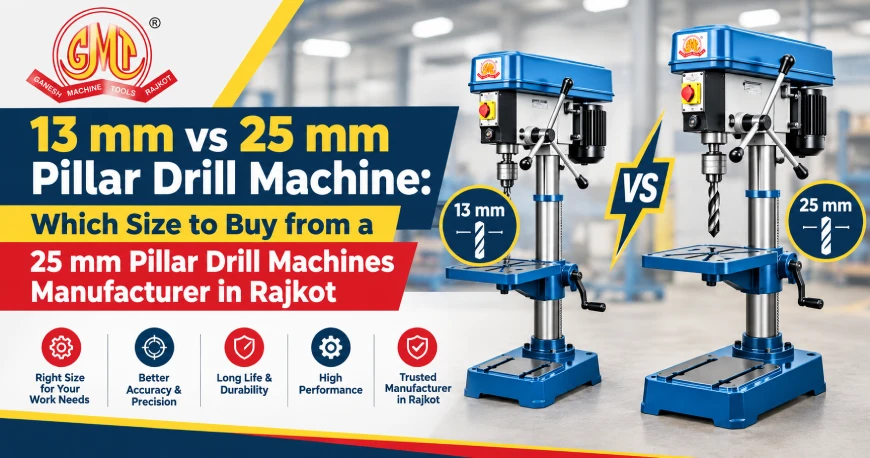
Pick the wrong pillar drill size and the mistake shows within months: a 13 mm machine stalling in thick steel plate, or a 25 mm machine taking up floor space and power for jobs a smaller drill would finish easily. This guide sets the two sizes side by side on capacity, spindle, motor, price and upkeep. It also lists what to ask a 25 mm pillar drill machines manufacturer in Rajkot before you order.
Choose a 13 mm pillar drill machine for light fabrication, maintenance and small steel work, and move to 25 mm when you regularly drill holes above 13 mm in steel, need an MT3 spindle for taper-shank drills, or want to add light milling later. The size of your largest regular hole should decide, not the size of your workshop.
How Do 13 mm and 25 mm Pillar Drill Machines Differ?
The headline number is the largest drill each machine can turn in steel, but the spindle and motor behind that number differ more than the number suggests. A 13 mm machine holds drills in a chuck on an MT2 spindle, while a 25 mm machine uses an MT3 spindle that takes taper-shank drills directly, which is what makes bits above 13 mm practical.
Rajkot listings show the typical 25 mm package. One model pairs an MT3 spindle with a 1 HP motor, 130 to 2,600 rpm and 112 mm of spindle stroke, another runs 90 to 3,000 rpm with a 152 mm stroke, and a third gives 250 mm between spindle and column. The table below compares typical figures for both classes.
| Feature | 13 mm class | 25 mm class |
| Spindle taper | MT2 | MT3 |
| Motor | 0.5 to 1 HP | About 1 HP |
| Speed range | About 300 to 2,500 rpm | About 90 to 3,000 rpm |
| Spindle stroke | 50 to 65 mm | 112 to 152 mm |
| Best for | Light fabrication, maintenance | Regular steel drilling above 13 mm |
Capacity labels vary between sellers, so treat them with care. Some Rajkot listings tag 13 mm machines as 20 mm, which means the rating in mild steel and the motor nameplate matter more than the title of the advertisement.
Weight and footprint also change between classes. A 25 mm machine is heavier and usually needs a firmer foundation, so confirm whether it is a bench or floor model and check the bench or floor can carry it.
Which Jobs Suit Each Size?
Job mix settles the question faster than any specification sheet, and the two sizes divide the work cleanly.
When 13 mm is enough
A 13 mm pillar drill covers most daily drilling in sheet, angle, flat bar and small steel parts. Hole sizes up to 13 mm fit the chuck, and a 0.5 to 1 HP motor handles them at around 600 rpm without strain. Maintenance shops, fabricators and tool rooms often run one for years and never feel the limit.
Small drills also run happily at the top of its speed range, so a 3 mm hole in aluminium or mild steel finishes quickly at around 2,500 rpm.
When 25 mm earns its place
A 25 mm pillar drill earns its place once holes above 13 mm appear every week. Torque demand rises roughly with the square of drill diameter, so a 25 mm bit asks for about 3.7 times the torque of a 13 mm bit at the same feed. In mild steel at 25 m/min, a 25 mm bit needs about 320 rpm against about 610 rpm for a 13 mm bit, and the stronger spindle is what makes that slow, heavy cut possible.
Pilot holes soften the load on either machine. Drilling a 12 or 13 mm pilot before opening up to 25 mm cuts the thrust the big bit must generate, because its chisel edge no longer has to push through solid metal.
Why Buy from a 25 mm Pillar Drill Machines Manufacturer in Rajkot?
Rajkot makers list both sizes side by side, which makes comparison easy. One manufacturer offers 13, 19, 25, 32 and 38 mm machines in a single heavy duty range, so stepping up later does not mean changing supplier. Another lists a 25 mm pillar drill with a one-year warranty.
Tooling cost follows machine size too, since taper-shank drills above 13 mm cost noticeably more than chuck-held drills, so budget for a few good bits when you step up.
Published prices help only at the small end. One Rajkot maker lists a 13 mm bench drilling machine at ₹25,000, while 25 mm prices are rarely shown. Ask for itemised quotes covering motor, spindle taper, table size, warranty and delivery, and compare them line by line.
Warranty terms deserve the same scrutiny. A one-year cover on motor and spindle is a reasonable baseline, with the wording on wear parts written down.
Buying direct also gives you the people who cast and assemble the machine. A manufacturer such as [Brand Name] should name the spindle bearings, show runout readings and quote lead times for belts, bearings and quill return springs. Push sideways on the head with one hand while watching the chuck, and clamp a dial indicator on the spindle to look for runout beyond 0.05 mm.
Should You Pick a 25 mm Drilling Cum Milling Machine Instead?
A drilling cum milling machine adds a cross-sliding table and a stiffer head to a pillar drill, so one machine drills holes and cuts keyways, slots and light faces. Rajkot listings include a bench model rated 25 mm with a 1 HP motor and a 300 mm height of centre, and another range offering 25 mm and 40 mm versions.
Milling puts side loads on the spindle that a plain pillar drill is not built for. A good 25 mm drilling cum milling machines manufacturer in Rajkot builds in a thicker column, adjustable table gibs and a quill lock to absorb them. Even so, treat the machine as a light milling tool for aluminium and mild steel, not a replacement for a proper milling machine.
If milling is occasional, a plain 25 mm pillar drill plus outsourced milling usually costs less than the combined machine.
What Else Should a Growing Workshop Plan Around the Drill?
Drill size is rarely the last machine decision, because growing workshops tend to add a lathe or a brake disc lathe next. Garages and fleet workshops in particular value a brake disc lathe, which corrects thickness variation on rotors and cures most noise and vibration complaints.
On-car machines cut the disc while it stays on the vehicle hub, and off-car machines need the disc removed first. A GMT on and off brake disc lathe machine manufacturer in Rajkot lists a brake drum disc skimming machine with a 400 mm processing diameter at ₹2,35,000, which gives a sense of the budget step above a drill.
Buying related machines from one supplier simplifies spares and service. Ask [Brand Name] or any shortlisted maker whether one visit can cover warranty on the drill, the lathe and the brake machine, and confirm the electrical load for all three before the first delivery.
Frequently Asked Questions
Is a 25 mm pillar drill better than a 13 mm one?
A 25 mm machine is better only if you drill above 13 mm regularly. It carries a stronger MT3 spindle, a longer stroke and more weight, but it also costs more and takes more floor space and power.
What motor does a 25 mm pillar drill machine need?
Rajkot listings commonly show 1 HP at 1,400 rpm for 25 mm machines. Steel work at full diameter benefits from the upper end of that range, so check the nameplate rating, not the brochure.
What spindle taper does a 25 mm pillar drill use?
Most 25 mm pillar drills use an MT3 spindle, while 13 mm machines use MT2. Check the taper before buying drills or arbors, since MT2 and MT3 shanks are not interchangeable without sleeves.
Can a 13 mm pillar drill machine make a 25 mm hole?
Not directly, because its chuck holds shanks only up to 13 mm. Reduced-shank bits exist but strain a 0.5 to 1 HP motor, so a pilot hole and a 25 mm machine make the better route.
Is a drilling cum milling machine better than a pillar drill?
It suits shops that also cut keyways and light faces. For drilling alone, a plain pillar drill costs less and does the job just as well.
Write down the largest hole you drill in steel each week and the largest you expect to drill next year. If both sit at 13 mm or below, buy the 13 mm machine and spend the savings on good drills. If either reaches 16 to 25 mm, ask a 25 mm pillar drill machines manufacturer in Rajkot for an itemised quote and a cutting trial on your own plate before paying any advance.